


In a context marked by unprecedented technological advances and the strategic challenges of the Military Planning Law (LPM), it is more imperative than ever to put in place high-performance «info-centric» defence systems. These systems are based on an optimum combination of cutting-edge technologies and a solid human and organisational component to ensure maximum efficiency.
While technology obviously plays an essential role in modern defence systems, providing advanced data collection, processing and analysis capabilities, the effectiveness of these systems can only be fully exploited by taking into account the human factor and the organisation that supports them.
The human component is crucial in defence operations. The skills, expertise and experience of military operators are essential assets for rapid and informed decision-making, as well as for adapting to complex and changing situations in the field. In addition, the interaction between operators and technological systems is fundamental to their optimal use. Training, skills development and human resource management are therefore key elements in ensuring an effective human component in «info-centric» defence systems.
The organisational aspect encompasses the structure, processes, protocols and activity flows that support defence operations. A well-designed organisation will promote coordination, collaboration and effective decision-making. It will also enable the best use to be made of available technological capabilities. Agile and adaptable, it is crucial to meeting the complex and evolving challenges of defence.
In this context, «info-centric» defence systems must be designed and developed taking into account the interaction between the technological, human and organisational dimensions. Since the effectiveness of these systems depends decisively on the performance of the human component, our integrated approach, in which technology is complemented by the expertise and adaptability of operators and by an agile organisation, is necessary to achieve the objectives.
By harmoniously integrating these different dimensions, Human design Group enables its customers to develop high-performance defence systems tailored to the complex challenges of our time.
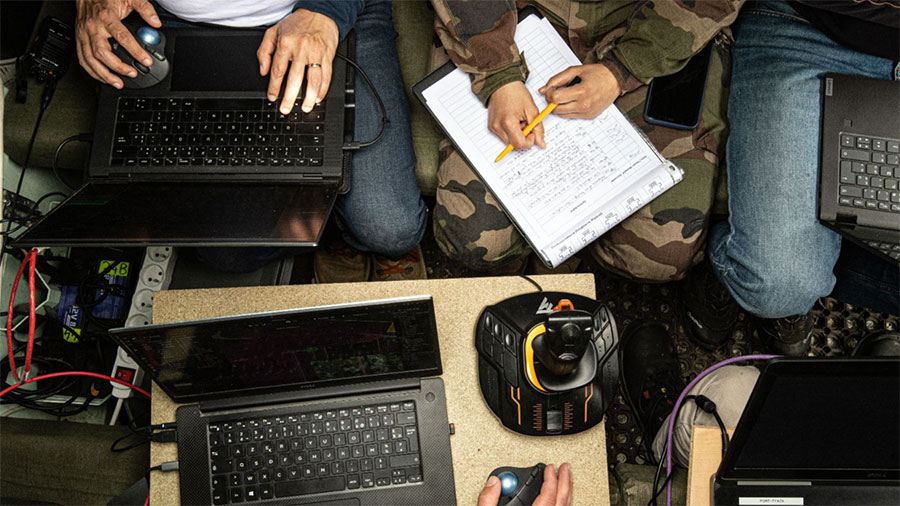
Photo credits: Armées de Terre
With more than 20 years' expertise in defence programmes, in collaboration with the DGA and defence engineering firms, Human Design Group is a key player in the design of physical and cognitive environments aimed at maximising the operational efficiency of human-machine interactions, particularly in complex defence environments.
Our approach is based on a unique combination of skills in human sciences and ergonomics, as well as the use of user-centred innovation methodologies and design solutions specifically designed to improve user performance.
We understand the crucial importance of designing environments that meet the needs and capabilities of human operators working with advanced technological systems. By taking into account both physical and cognitive aspects, we create environments that optimise performance and promote fluid interactions between human and machine.
Our expertise in eregonomics and, more generally, in the human sciences, enables us to carry out in-depth analyses of user needs, constraints and capabilities in specific operational contexts. We use tailor-made methodologies to gather qualitative and quantitative data, to obtain a precise understanding of the challenges and opportunities associated with human-computer interaction.
Thanks to this user-centred approach, we are able to develop innovative, tailored design solutions that take account of specific usage and operational requirements. Our ultimate aim is to create environments that improve user performance by facilitating decision-making, responsiveness and adaptability to the complex and changing situations encountered in the field.
Our expertise lies in the design of socio-technical systems, transforming operational needs into solid design requirements. We create innovative and reliable organisations while offering exceptional ergonomics through virtual reality and convincing Proof of Concepts. Our thorough evaluation ensures robust performance by anticipating human error and analysing workload.
Photo credits: Arnaud Woldanski/armée de Terre/Défense
We define and implement Human Factors Integration Plans (HFIPs), enabling our customers to meet Human Factors requirements while demonstrating the conformity of design solutions (requirements matrix, DERG, DJD).
We analyse and provide a detailed understanding of the operational needs and activities of operators. This is done in order to identify the ergonomic requirements and recommendations applicable to the project. Once the layout principles have been defined (sketches / APS / APD / DCE) for the spaces and workstations (DD and DJD), we evaluate the layouts with the end-users on 3D, 1:1 scale models or in virtual reality (VR).