


At a time when 93 %* companies are struggling to find their way strategically in the technological landscape, how can you ensure that your concepts meet real needs while managing your investments?
*Source: 2022 BCG Digital Maturity Global Study; n = 2,677 in 13 countries.
▶ To ensure successful innovation and the transformation of your operational concepts into validated, market-adopted solutions, it is essential to recognise that there is no such thing as a purely technological system. Systems are intrinsically linked to end-users, and their success depends directly on their ability to meet human needs. An approach based solely on technological maturity or technical performance is not sufficient.
By incorporating a human-centred assessment from the earliest design phases, you can ensure that your solutions are not only functional, but also perfectly adapted to users' expectations, capabilities and behaviours. This approach allows you to identify and resolve problems of ergonomics, usability and human-machine interaction before they become costly and difficult obstacles to overcome.
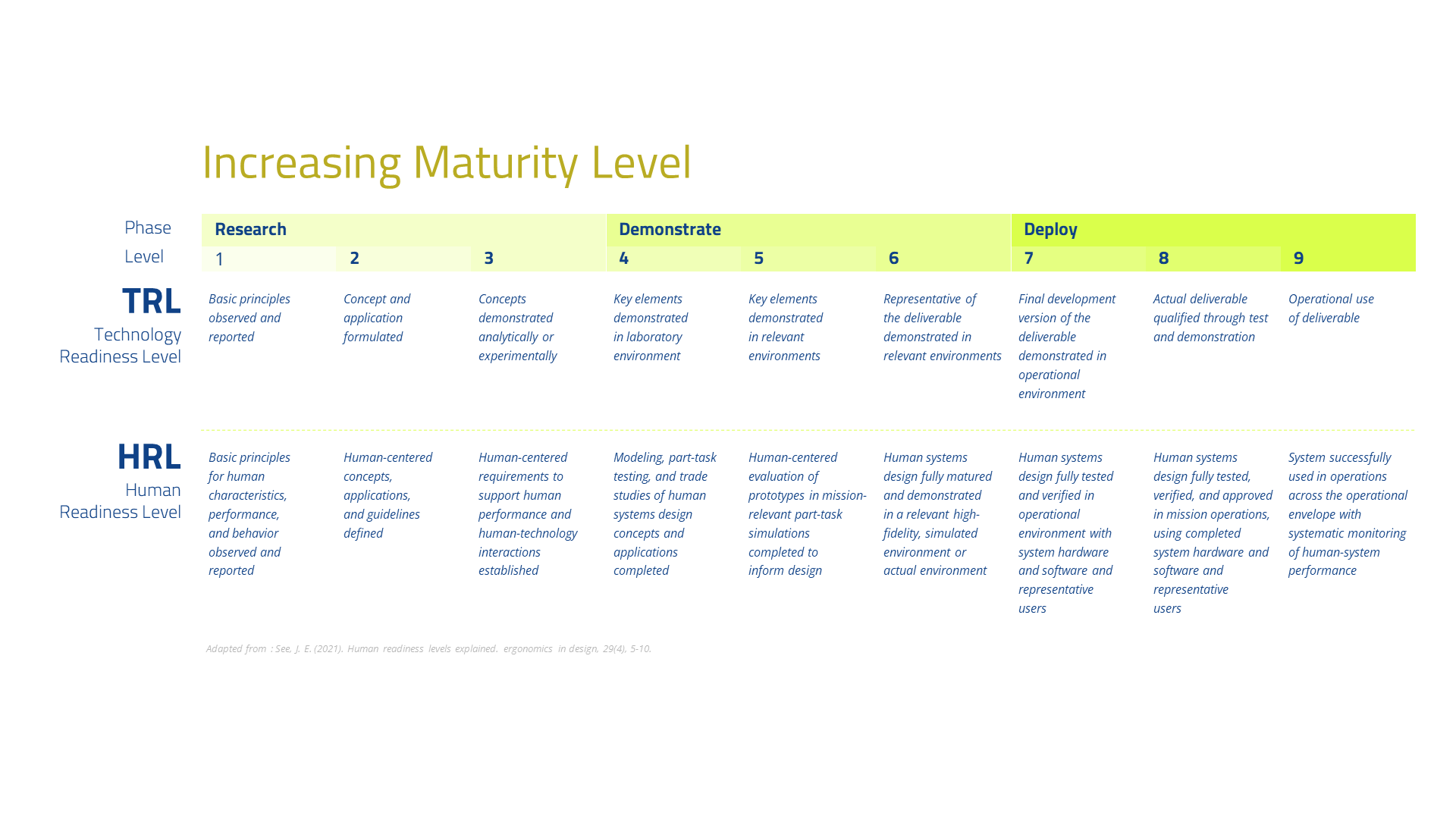
▶ While technological maturity guarantees that your systems work properly, it is not enough on its own to ensure that they are easy to use and perform well in real environments. HRL assessments enable you to detect and resolve problems relating to ergonomics, human performance and interactions at an early design stage.
Reduce the risk of operational failure and the costs associated with late changes by adopting a people-centred approach. Maximise the adoption and effectiveness of your solutions, while boosting your competitiveness with systems that are perfectly tailored to the expectations and capabilities of your end-users.
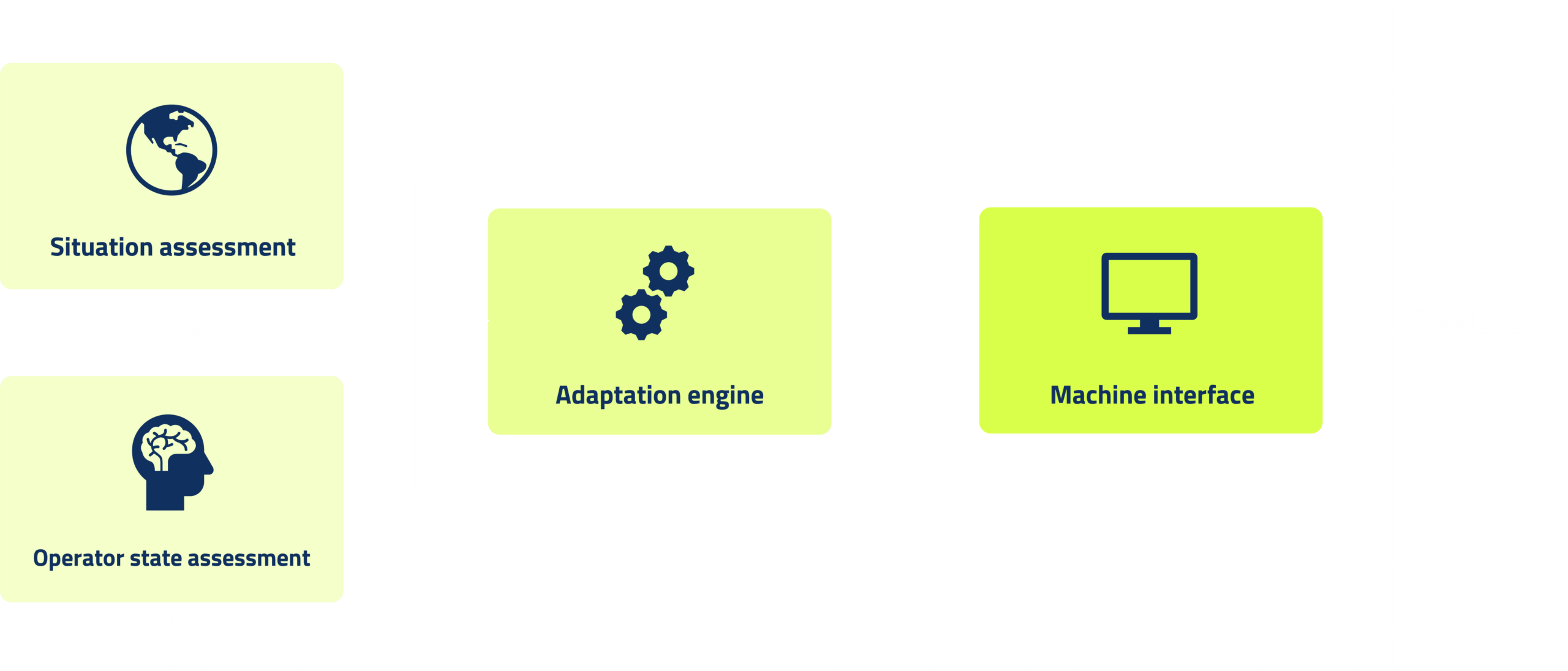
Conceptual framework for an intelligent adaptive interface system (reproduced from Hou et al. (2015, 2022)).
1. Perceive
Models and data collection :
2. Analyse and decide
Decision rules :
3. Take action
Adapting the GUI :
▶ Today's engineering teams demand solutions that combine technical rigour with seamless integration at the heart of their operational processes. To meet these challenges, we have developed proprietary technological tools from our own R&D, specifically designed and proven to adapt to the real needs of your experts.
Human Data Science analyses technical requirements and relevant indicators to measure performance. Human Immersion Science uses protocols and technologies to carry out immersive tests in real-life conditions. Finally, Human Augmentation Science analyses human-machine interaction to find ergonomic and intuitive solutions.
Maximise your return on investment by leveraging a robust data strategy tailored to your specific needs. Whether you need to map critical challenges or focus on a specific aspect of your target system, our team of experts is here to guide you. Together, we'll identify the protocols best suited to your needs and ensure the best use of leading-edge technologies, solutions and expertise at every stage of your project.
Aim just right
From the initial exploration of key issues to the final certification process, we deploy the most effective tools and methodologies to meet your needs throughout the design cycle. Our approach enables you not only to stay within budget, but also to achieve superior results by harnessing the power of data-driven insights. With our support, you can confidently tackle complex challenges, make informed decisions and drive innovation while maintaining operational excellence.
While it is essential to anticipate technological challenges, the true measure of transformation lies in its practical application. Immersive technologies, while powerful, require a bespoke protocol to deliver optimal results. Our approach not only optimises results with a data strategy tailored to your needs, but also ensures security and mitigates the associated risks.
It's not a game
Immersive technologies should not be taken lightly. We help our clients take into account the health and ethical considerations involved in capturing and executing experimental protocols. With our expertise, you can confidently navigate the complexities of immersive technology, ensuring that your projects are not only innovative, but also responsible and effective.
The designer is not the operator. Beyond ambitions, accelerating the deployment of a new concept requires anticipating the alignment between the system and future activities. It is by measuring this gap and integrating human factors that the real value and expected performance are revealed.
The art and the way
Unlock the full potential of your project by putting it to the test. This will enable you to anticipate training needs and guarantee reliability in real-life situations. Our approach helps you to quickly identify and correct discrepancies, ensuring that your innovations are not only technically sound, but also perfectly integrated into operational environments. This proactive strategy ensures that your projects deliver on their promises and produce tangible results.
Control every stage of your design cycle
with an approach that secures your technological and financial ambitions.

Identify
value-driven impact
By integrating HRL with advanced tools such as VR/AR/XR and biometric sensors, you can identify exactly where the real added value lies.
Our resources enable you to test and evaluate your ideas cost-effectively, ensuring a seamless launch or roll-out strategy.
By identifying critical areas early on, you minimise the need for costly corrections, saving both time and resources.

Guarantee
design performance
Our approach ensures a 360-degree design cycle that leaves nothing to chance. By leveraging the science of human data, the science of immersion and the science of augmentation, you eliminate blind spots that could lead to costly oversights later in the development process.
This comprehensive assessment ensures that your designs are not only technically sound, but also perfectly aligned with user needs and expectations.

Check
your investment
Stay within your forecast budget by avoiding the additional costs associated with corrections and modifications resulting from a misunderstanding of the real needs of end users.
By integrating human-centred design expertise with cutting-edge technologies, you can optimise your investments, reduce the risk of unexpected expenditure and ensure a smoother, more profitable development process.
In recent years, new relationships between man and machine have gradually emerged. The integration of autonomous systems and artificial intelligence into human activities raises new design challenges.
It's a revolution in the making, and one to which we are contributing through our assessing the performance of human-machine collaboration.
Space is a powerful accelerator of technological innovation. It must invent the solutions of the future for stays in constraining environments such as the Moon.
We support this process with our multi-sector expertise in ergonomics and human factors, in order to define the conditions necessary for living and maintaining life in the area.
We're at the cutting edge of exploring new uses. As such, we have’a number of reference use cases in the integration of artificial intelligence systems into complex systems.
To meet these operational and forward-looking challenges, we have developed expertise, methodologies and technological assets that are unique on the market.
Contact us to discuss the best strategy for your project!