Ergonomics and Human Factors

Hidden costs

Hidden costs :
An underestimated performance potential

Did you know that every year your company loses tens of thousands or even millions of euros through invisible costs? These unidentified expenses are the result of human error, sub-optimal organisation, poorly used tools or high staff turnover. Yet these losses are not inevitable.

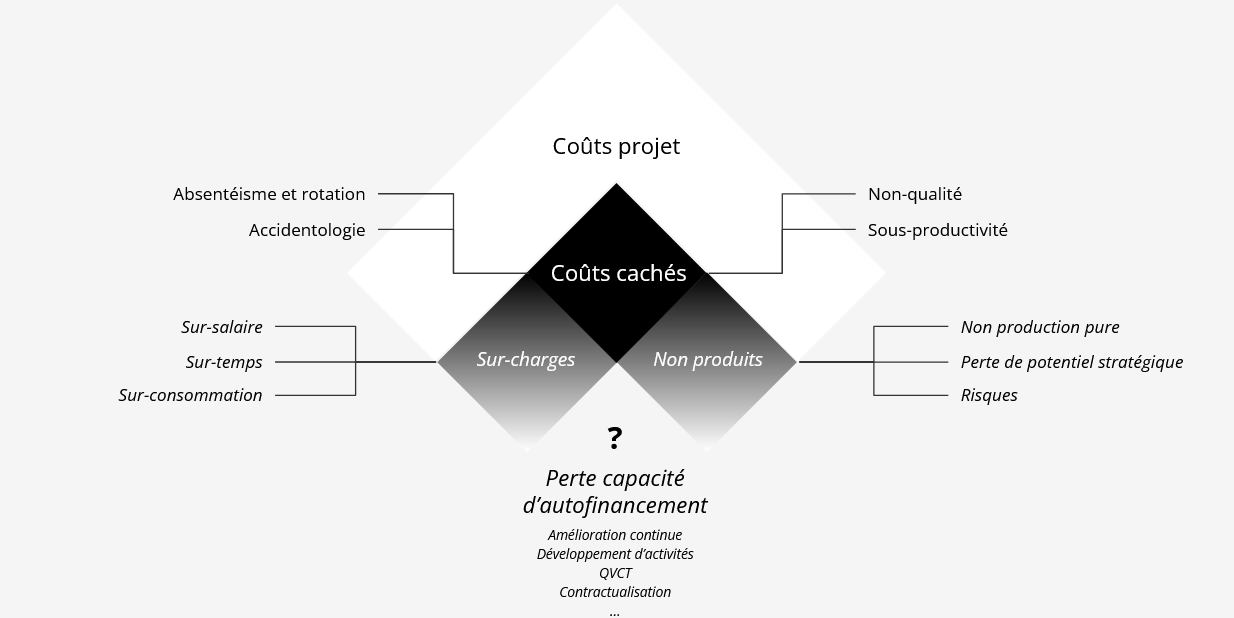
Companies have always sought to optimise their performance by cutting costs. Yet a significant proportion of financial losses are not directly reflected in the balance sheet. These invisible costs - the hidden costs - result from organisational dysfunction, productivity losses, poor coordination or under-utilisation of in-house skills.

The hidden cost method

It was in the 1970s that Professor Henri Savall and his team at ISEOR (Institut de Socio-Économie des Entreprises et des Organisations) developed the hidden cost-performance method. Their research was based on a striking observation: by studying 1,854 companies over several decades, they demonstrated that a large proportion of operating costs were neither measured nor controlled by conventional accounting tools.

Together with Henri Savall and ISEOR, Laurent Cappelletti has helped to develop and structure this approach by integrating it into modern management and performance control practices. His work has made it possible to objectify the impact of hidden costs even further and to refine the methods for transforming them into measurable, actionable gains.

«Hidden costs are fairly easy to reduce
from 35 % to 55 % using appropriate tools and processes. « 

"Forty years after its invention: the hidden cost method"."
Cappelletti, Laurent ; Voyant, Olivier ; Savall, Henri | ACCRA | 2018-05-14 | p. 71-91 | 2018

Identifying and exploiting hidden costs

Human design Group builds on these advances to offer concrete, operational solutions, integrating human factors and ergonomics into the analysis of hidden costs.

Ergonomics and human factors engineering enable our customers to objectify and optimise performance, revealing unsuspected sources of value and self-financing capacities that were previously ignored.

The hidden costs method is based on a rigorous scientific approach, using field observations and advanced diagnostic tools. It enables :

  • Precisely identify the malfunctions causing financial losses.
  • Assess their real impact, which is often underestimated by traditional analyses.
  • Design targeted corrective solutions tailored to the specific needs of each organisation.
  • Measure the gains made after implementing improvements.

Today, this approach is used in sectors as varied as industry, health, services and public administration. Not only does it improve the profitability of companies, it also enhances the quality of working life and optimises internal processes.


Understanding

What you don't see... costs you dearly

Hidden costs don't appear in conventional financial tables, but they have a direct impact on your profitability and competitiveness. They take different forms:

  • Errors and misunderstandings that slow down processes
  • Costly corrections
  • Ineffective tools and systems poorly adapted to actual use
  • Stress and cognitive overload affecting team productivity
  • Turnover and absenteeism leading to recurring recruitment and training costs
Design

Analysis
optimisation

Ergonomics and Human Factors Engineering provide a concrete response to this challenge.

  • Mapping hidden costs - Identifying financial and operational losses linked to human interactions and internal processes.
  • Performance evaluation - Analysis of malfunctions and levers for improvement using an approach centred on usage and the real needs of employees.
  • Optimising systems and processes - Designing ergonomic solutions that integrate human factors right from the design phase, for improved performance and a better return on investment.

The aim is simple: to transform these invisible losses into measurable gains and strategic opportunities.

Assess

A profitable investment
and measurable

According to studies conducted by Laurent Cappelletti (CNAM / Lirsa) on thousands of companies, one euro invested in improving human factors engineering generates up to €4 return on investment, by reducing hidden costs and optimising team efficiency.

  • Reducing errors and incidents
  • Improved comfort and quality of work
  • Increased employee commitment
  • Optimising operational flows and decision-making

By incorporating these improvements into the design of your tools, spaces and processes, you can maximise the profitability and sustainability of your organisation.

«1 well invested in management quality yields 4 euros on average,
quality of life at work».»

Laurent Cappelletti
Professor at the CNAM and Director of Programmes at ISEOR
Take action

Transform your hidden costs
as a performance driver

Don't let hidden costs hold back your growth and competitiveness.

Contact our experts today for a personalised diagnostic and find out how to optimise your performance while improving the experience of your employees.

Sectors

Energy

Industry

Defence and security

Key references

Control rooms

Human Factors Integration

Immersion organisation

Question:

How can organisational design help with change management?

Combining locations and activities