



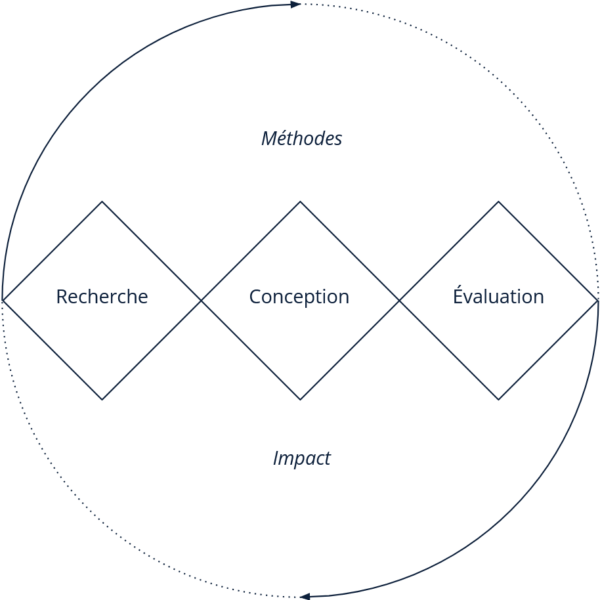
The human-centred design process has evolved over time to meet the changing needs of users and businesses. Inspired by the Double Diamond model, which emphasises the discovery and definition of problems, as well as the creation and delivery of solutions, Human design Group has developed its own three-diamond model incorporating the evaluation and objectification of the impact of solutions.
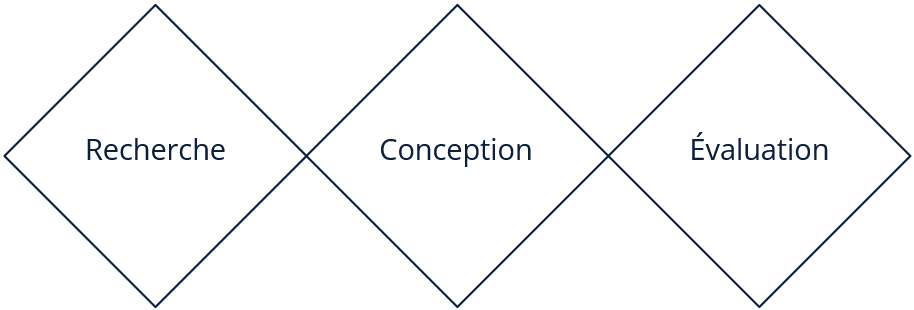
This Three Diamond Model integrates a holistic approach to human-centred design, adding a third essential phase: the question of feasibility and evaluation, objectification measured at the end of the design cycle. This model extends the perspectives of the design process by considering not only the field of possibilities and user research, but also the desirability criterion attached to the design, and viability through objectification, evaluation and even certification, depending on the case.
The first diamond is therefore devoted to the fields of possibilities to be explored, and in particular to user research. This is an exploratory phase in which designers and researchers immerse themselves in the world of users to understand their needs, aspirations and challenges. This stage includes techniques such as observation, interviews and user tests, which provide valuable information to guide future design.
The second diamond focuses on desirability and the design phase. In this phase, ideas are generated, concepts are explored and solutions are designed to meet previously identified user needs and expectations. The aim is to create captivating and attractive user experiences, using methods such as prototyping, design thinking and co-creation.
Finally, the third diamond in the three-diamond model focuses on feasibility and evaluation. At this stage, conceptual solutions are tested, evaluated and iterated to verify their technical, economic and organisational viability. Approaches such as feasibility testing, objectivisation of results and impact analysis are used to evaluate outputs and make informed decisions about their strategic implementation.
By combining possibility, desirability and feasibility, the Three Diamond Model offers a complete approach to human-centred design that integrates the effective completion of the design cycle. It enables Human design Group to create innovative, relevant and feasible solutions, taking into account real needs, objectives and contexts.
Ergonomics and Human Factors Engineering (HFE) are essential scientific disciplines for designing systems that take into account human capabilities and limitations. According to the international standard ISO 26800, ergonomics is defined as «the scientific discipline concerned with understanding the interactions between humans and other elements of a system, and the profession that applies theoretical knowledge, principles, data and methods to the design and evaluation of tasks, workstations, products, tools, environments and systems, in order to make them compatible with people's needs, abilities and limitations».
In France, ergonomics is also recognised as a humanities and social sciences discipline, covering a number of key issues such as :
Human factors engineering integrates methodologies and tools to optimise human performance and safety in complex systems. These disciplines aim to improve the well-being, safety and efficiency of users by adapting tools, machines and working environments to their needs.
Human design Group, a pioneer in the field of ergonomics and AI consulting, has been working for many years with companies of all sizes, from major accounts to innovative start-ups. Backed by major references, Human design Group brings its expertise to bear in integrating artificial intelligence (AI) into a variety of systems, highlighting the crucial importance of human factors in guaranteeing strategic relevance, performance gains, reliability and risk reduction.
Find out more about our support in transforming satellite supervision through a detailed analysis of activities, the design of optimised spaces and an innovative organisation incorporating artificial intelligence.
Find out about our strategic support for an out-of-home delivery service, mobilising internal and external stakeholders around in-depth user research and a shared, co-constructed vision.
Following on from the man-machine design and ergonomic approaches applied to its medical device, we supported our customer throughout the process, right through to final certification.